For decades, Ugandans judged S.4 results with one question: "Did you get a first grade?" Aggregates and Divisions 1 to 4 were easy to compare. Then the competence-based curriculum (CBC) arrived, and with it a new UCE grading system that confused many parents when the first results came out in 2025.
This article explains it simply.
What changed?
| Old system | New system (CBC) |
|---|---|
| Subjects graded 1 to 9 (D1, D2, C3 … F9) | Subjects graded with letters A, B, C, D, E |
| Best 8 subjects added to get an aggregate | No aggregate |
| Candidates ranked in Divisions 1, 2, 3, 4 or U | No divisions; a Result 1, 2 or 3 for the certificate |
| Final exam only | Final exam plus school-based continuous assessment |
| Result slip | Transcript and certificate |
The idea behind the change is that the curriculum now values what learners can do with knowledge, not only what they can remember on exam day.
What do grades A to E mean?
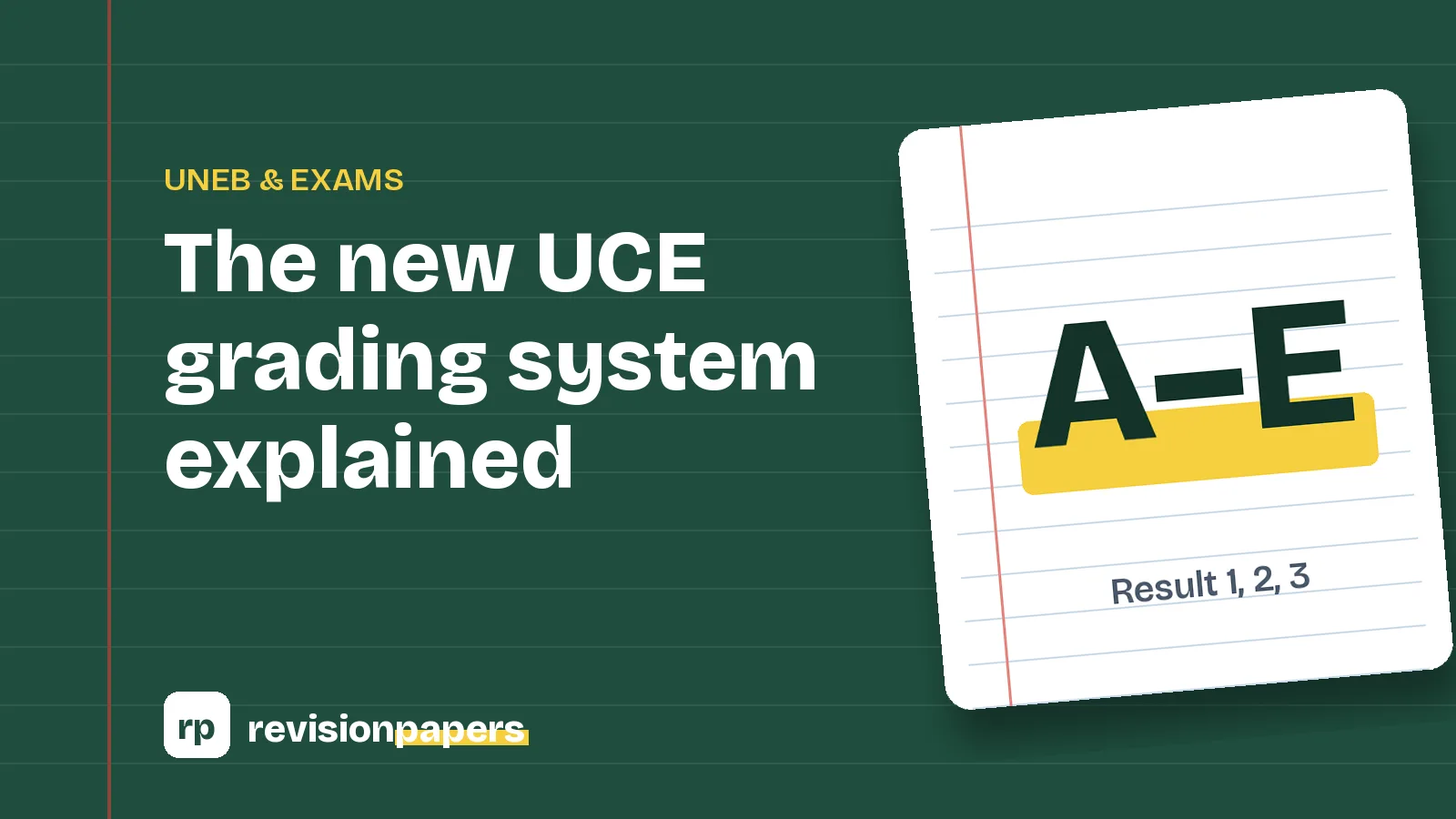
Each subject gets a letter grade that describes the learner's level of competence:
| Grade | Achievement level | What it means |
|---|---|---|
| A | Exceptional | Has mastered the subject and applies it confidently, even in unfamiliar situations |
| B | Outstanding | Very good understanding and application |
| C | Satisfactory | Has achieved the expected competences |
| D | Basic | Has the basic competences, with gaps |
| E | Elementary | Has not yet reached the basic level |
How is the grade calculated?
A subject grade combines two things:
- Continuous assessment (CA): 20%. These are school-based scores from activities of integration, projects and other assessments done during S.1 to S.4, submitted to UNEB by the school.
- End-of-cycle examination: 80%. The UNEB papers sat in S.4.
This means that what a learner does in class over four years counts. A student who skips projects or whose scores are not submitted by the school can be disadvantaged.
What do Result 1, Result 2 and Result 3 mean?
This is where most of the confusion comes from. The Result number is not a grade or a division. It only tells you whether the candidate qualifies for the UCE certificate.
- Result 1: the candidate qualified for the UCE certificate. To qualify, a candidate must have sat the required subjects (at least eight) and reached at least grade D in at least one subject. Most candidates get Result 1.
- Result 2: the candidate did not meet the conditions for the certificate, usually because they did not complete all the required subjects or assessments such as project work. They still receive a transcript.
- Result 3: the candidate got grade E in all subjects, so did not reach the minimum for a certificate. They also receive a transcript.
So Result 1 does not mean "first grade". A learner with mostly Ds and a learner with all As both have Result 1. To compare performance, read the subject grades.
How are students selected for Senior Five now?
Without aggregates, A-Level schools look at the grades in the subjects that matter for the combination a learner wants. A student who wants to do Physics, Chemistry and Mathematics will be judged mainly on those grades. Top schools usually look for As and Bs in the relevant subjects; requirements differ from school to school.
Read our full guide to Senior Five selection.
What does this mean for S.1, S.2 and S.3 learners?
The new system rewards consistent work:
- Take activities of integration and projects seriously. They count towards your final grade.
- Practise applying knowledge. UNEB questions now describe real-life scenarios and ask you to solve a problem, not only to define terms. Practise with UCE past papers and our quizzes.
- Do not neglect any subject. You need certain grades in the subjects you want for A-Level.
A note for parents
When your child's results come home:
- Do not compare Result 1 with someone else's Result 1. Compare the subject grades.
- Look for patterns. Strong grades in sciences, or in languages and humanities, point to suitable A-Level combinations or courses.
- Talk to the school about continuous assessment if a grade looks very different from what you expected.
For more on supporting your child, read how parents can support exam candidates.
Key points
- Subjects are graded A, B, C, D, E by level of competence.
- 20% of the grade comes from school continuous assessment, 80% from the UNEB exam.
- Result 1 means the learner qualifies for the certificate. It is not a ranking.
- To judge performance, read the subject grades.
Official sources: Uganda National Examinations Board (UNEB) and the National Curriculum Development Centre (NCDC).